
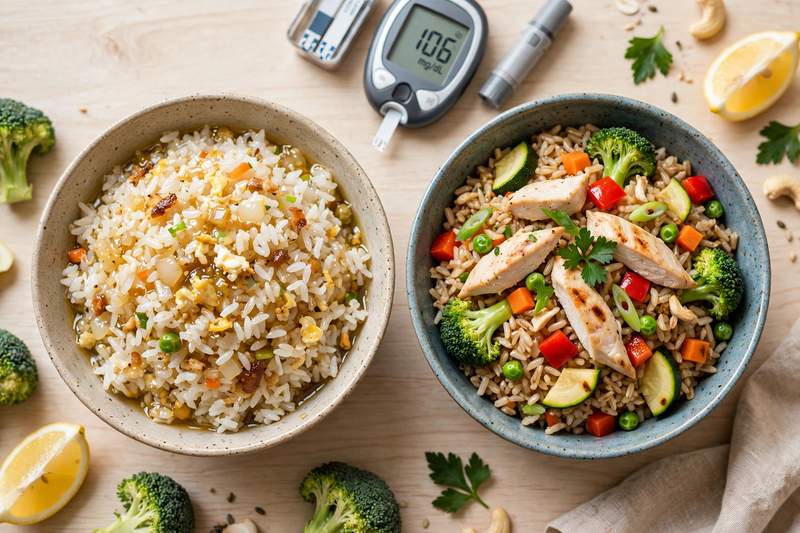
Is fried rice bad for diabetics? What every diabetic should know starts with something Maria noticed after her Friday takeout habit: her favorite order of fried rice kept sending her blood sugar higher than she expected, even on weeks she’d otherwise eaten carefully.
Diabetic diet advice can feel confusing, especially with dishes like fried rice that show up at almost every takeout order and family dinner. A lot of people just want a straight answer: do they have to give up fried rice completely, or is there a way to still enjoy it?
The honest answer sits somewhere in between, and it depends more on how the dish is made than most people expect. That’s really the heart of is fried rice bad for diabetics? What every diabetic should know questions in the first place.
What Is Fried Rice?
At its core, fried rice is cooked rice, usually white rice, stir-fried in oil with soy sauce, egg, vegetables, and often some kind of meat or shrimp. Restaurant versions tend to lean heavily on rice and oil, with vegetables and protein playing a smaller supporting role.
That balance matters a lot for blood sugar, since it’s mostly what’s determining how much of an impact any given plate will have.
Why Fried Rice Can Be Problematic for Diabetics?
A few factors combine to make fried rice trickier than it looks:
- High glycemic index of white rice – standard white rice digests quickly, releasing glucose into your bloodstream fast
- Large portion sizes – restaurant portions often contain far more rice than a single balanced serving should
- High oil and sodium content – frying adds calories and fat, and sauces add sodium, neither of which directly spikes blood sugar but both affect overall health
- Low fiber – white rice has very little fiber, so there’s nothing slowing down digestion
- The combination effect – a big portion of low-fiber, high-GI rice, cooked in oil, tends to spike blood sugar faster and higher than a smaller, more balanced plate would
Understanding these factors is really the first step in answering is fried rice bad for diabetics? What every diabetic should know before making any changes.
Glycemic Index and Blood Sugar Impact
White rice generally sits at a high glycemic index, often in the high 70s to high 80s depending on the variety, meaning it raises blood sugar quickly. Brown rice runs meaningfully lower, generally in the low-to-mid 50s, thanks to its intact fiber layer.
Cauliflower rice, which isn’t rice at all but a low-carb substitute made from finely chopped cauliflower, has a glycemic index low enough that it barely registers on the same scale, since it contains a fraction of the carbohydrates.
Think of it like three different speeds on the same road. White rice is the fast lane, brown rice a moderate pace, and cauliflower rice barely moving compared to the other two.
Is Fried Rice Bad for Diabetics? The Honest Answer
Is fried rice bad for diabetics across the board? Not exactly. It depends on the type of rice used, the portion size, what else is mixed in, and how it fits into your overall day of eating. A small portion of vegetable-heavy fried rice made with brown rice looks very different, blood-sugar-wise, than a large restaurant portion made mostly of white rice and oil.
It isn’t something that needs to be completely off the table for most people with diabetes, but it does usually need some modification to fit comfortably into a diabetes-friendly diet.
Is Fried Rice Bad for Diabetics? What Every Diabetic Should Know About Portions
Is fried rice bad for diabetics if portions are kept in check? Generally, no. A half-cup to three-quarter-cup portion, especially when the dish is built around vegetables and protein rather than rice, tends to have a manageable impact on blood sugar for most people. Individual results vary depending on your overall health and how well-managed your diabetes is, so it’s worth testing your own response rather than assuming.
7 Ways to Make Fried Rice Diabetes-Friendly
1. Use brown rice or cauliflower rice
Swapping the base ingredient alone makes a meaningful difference, since both options carry more fiber (or far fewer carbs, in cauliflower’s case) than standard white rice.
2. Add more vegetables than rice
Flip the usual ratio. Instead of rice with a few vegetables mixed in, aim for a dish that’s mostly vegetables with rice as a smaller component.
3. Add lean protein
Chicken, shrimp, tofu, or egg all slow down digestion when eaten alongside the rice, softening the overall blood sugar response.
4. Use less oil
A light coating is enough to stir-fry effectively. Heavy oil doesn’t affect blood sugar directly, but it adds unnecessary calories that can work against broader health goals.
5. Use low-sodium soy sauce
This doesn’t change the blood sugar impact directly, but it supports better overall health, particularly for anyone also managing blood pressure.
6. Control portion to 1/2-3/4 cup
Measuring rather than eyeballing keeps portions consistent and predictable, which makes it much easier to track how your body responds.
7. Eat vegetables and protein first
Eating the non-starchy parts of the meal before the rice can modestly slow down how quickly the carbohydrates hit your bloodstream.
These seven swaps are usually the most practical answer to is fried rice bad for diabetics? What every diabetic should know once you move past the yes-or-no question.
What Type of Rice Is Best for Diabetics?
| Rice Type | Glycemic Index | Fiber | Best For |
|---|---|---|---|
| White Rice | High (72-89) | Low | Occasional use, small portions |
| Brown Rice | Moderate (50-55) | Higher | Regular use, better everyday choice |
| Basmati Rice | Moderate (52-58) | Moderate | Good middle-ground option |
| Quinoa | Low-Moderate (53) | High | Great substitute, higher protein too |
| Cauliflower Rice | Very Low | Low, but low-carb overall | Lowest blood sugar impact by far |
For a deeper breakdown of white versus brown rice specifically, our guide on can diabetics eat rice, white vs brown rice GI chart covers more varieties in detail. If you’re deciding between basmati, jasmine, and brown rice generally, we compared those head-to-head in best rice for diabetics: basmati vs jasmine vs brown.
According to the American Diabetes Association, choosing higher fiber carbohydrate sources is one of the more consistent ways to support steadier blood sugar throughout the day.
Real-Life Experiences and Practical Observations
A common mistake is treating fried rice as a side dish while actually eating a full dinner plate’s worth of it. Restaurant portions especially tend to be much larger than what most people would serve themselves at home.
People who switch to brown rice or cauliflower rice versions, while adding more vegetables, often report a noticeably steadier blood sugar reading afterward. What surprises a lot of people is how filling a vegetable-heavy version can be, even with less rice overall, which makes the swap easier to stick with than expected.
Consistency in portion size matters more than any single ingredient change. People who measure their rice regularly tend to have a more predictable blood sugar pattern than those who estimate.
Common Mistakes to Avoid
- Eating large restaurant-style portions
- Using too much oil during cooking
- Eating fried rice on an empty stomach, without any protein or vegetables first
- Skipping vegetables and making it mostly rice
- Eating restaurant-style fried rice on a daily basis
Additional Lifestyle Tips for Rice Lovers with Diabetes
- Practice consistent portion control, measuring rather than estimating
- Pair rice-based meals with fiber and protein every time
- Take a short walk after meals when possible
- Track your blood sugar response to different rice dishes to learn your own patterns
The Mayo Clinic notes that whole grains generally support better blood sugar management than refined grains like white rice, which lines up with why brown rice and similar swaps tend to help.
Frequently Asked Questions (FAQ)
Can diabetics eat fried rice?
Yes, in moderation. Choosing brown rice or cauliflower rice, adding vegetables and protein, and controlling portion size all make it easier to fit into a diabetes-friendly diet.
How much fried rice can a diabetic eat?
A half-cup to three-quarter-cup portion is a reasonable starting point for most people, adjusted based on your own blood sugar response and overall carb budget.
Is brown fried rice better?
Generally, yes. Brown rice has more fiber than white rice, which slows digestion and tends to produce a steadier blood sugar response.
Is egg fried rice ok for diabetics?
Yes, and the egg actually helps by adding protein, which can soften the overall blood sugar impact of the meal.
Does fried rice raise blood sugar a lot?
It can, particularly large, white-rice-heavy portions. Smaller portions with more vegetables and protein have a much gentler effect.
What is the best rice for diabetics?
Cauliflower rice has the lowest impact by far, followed by brown rice, basmati, and quinoa. For a full portion guide, see our article on how much rice can a diabetic eat per meal.
Can I eat chicken fried rice with diabetes?
Yes. The added protein from chicken can help slow digestion, making it a reasonable choice, especially with a moderate portion and added vegetables.
How do I make fried rice without raising blood sugar too much?
Use brown or cauliflower rice, load up on vegetables, add lean protein, keep the oil light, and measure your portion instead of eyeballing it.
Final Thoughts
So, is fried rice bad for diabetics? What every diabetic should know is that it isn’t an all-or-nothing situation. The type of rice, the portion size, and what else is on the plate all shape how it affects your blood sugar. With a few simple swaps, brown or cauliflower rice, more vegetables, a reasonable portion, fried rice can still have a place in a diabetes-friendly diet. Track your own response, adjust as you learn, and check in with your healthcare provider if you have questions about fitting it into your overall plan.
Medical Disclaimer: This article is for informational purposes only and is not intended as medical advice. It is not a substitute for professional medical advice, diagnosis, or treatment. Readers experiencing persistent high blood sugar or worsening symptoms should consult a qualified healthcare provider before making diet changes.